HHZ Vapes17 products
 H2 Superior21 Vapes
 Flowers61 products
 I Love Pot
 Sheesh
 OnlyGrams
 Canapuff




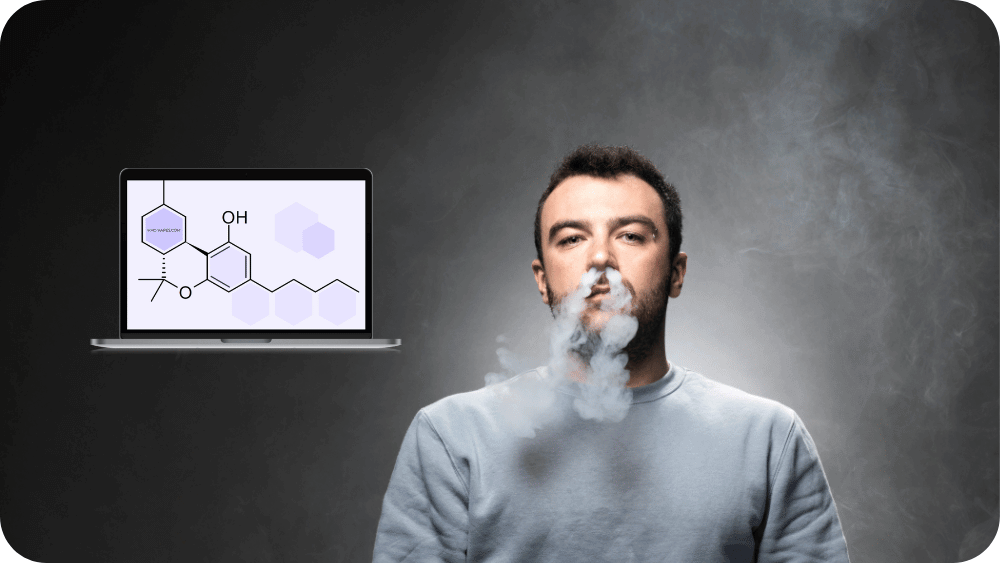
Table of contents
- What is HHC?
- How is HHC produced?
- History of HHC: from Roger Adams to the EU Early Warning System
- HHC effects: what research knows
- Is HHC dangerous? Side effects and risks
- Is HHC a drug? The classification in plain words
- HHC vs THC: the chemical difference
- Is HHC legal? The legal situation in Germany
- HHC-P, HHC-O and 8-OH-HHC: what the abbreviations mean
- HHC in Austria, Switzerland and internationally
- What this means for buyers today
- Frequently asked questions about HHC
In short: HHC (hexahydrocannabinol) is a semi-synthetic cannabinoid made from CBD in the lab. It binds to the same receptors as THC, and users described the effects as cannabis-like, but controlled studies in humans are largely missing. The BfR describes risks up to and including psychosis. In Germany, HHC has been banned since 27 June 2024 and has been listed in Annex II of the BtMG since 23 May 2026, which makes possession a criminal offence too (as of October 2026).
HHC is the abbreviation for hexahydrocannabinol, a semi-synthetic cannabinoid obtained from CBD in the lab. In the hemp plant itself, it occurs at most in traces. In Germany, HHC has been banned since 27 June 2024, initially under the New Psychoactive Substances Act (NpSG). Since 23 May 2026, it has been listed in Annex II of the German Narcotics Act (BtMG), which makes trade and also possession punishable (as of: October 2026). The substance became known from 2022, when it appeared freely available in vapes and sprayed flowers. Today, HHC is mainly a topic for chemistry, research and law.
What is HHC?
It belongs to the substance class of cannabinoids, which also includes THC and CBD. The name describes the structure: "hexahydro" means that the molecule carries six more hydrogen atoms than cannabinol (CBN), a breakdown product of THC. Compared to delta-9-THC (molecular formula C21H30O2), it lacks the double bond in the upper ring. In its place are two additional hydrogen atoms, and the molecular formula is C21H32O2. This saturated structure makes the substance chemically more stable against oxygen and light.
Production almost always results in a mixture of two forms that differ only in the spatial position of a methyl group: 9R-HHC and 9S-HHC, also called β-HHC and α-HHC in the scientific literature. This difference is important for research. According to the evaluation by the German Federal Institute for Risk Assessment (BfR), it is mainly β-HHC that is pharmacologically active, α-HHC much less so. The properties of a product therefore depended on the mixing ratio of the two forms, and that varied from batch to batch.
A quick heads-up first: HHC is banned in Germany, so there are no HHC products in the shop anymore. The category page explains what became of the former HHC vapes. To see which substances have taken their place, check out the guide HHC alternatives and the categories HHZ vapes and H3 vapes.
How is HHC produced?
The route described in the literature starts with CBD. According to the technical report of the EU drugs agency EUDA (then EMCDDA), the substance is synthesised from CBD extracted from low-THC industrial hemp. This makes it the first semi-synthetic cannabinoid reported in the EU. Chemically, this happens in two steps: first, CBD is rearranged into THC isomers under the influence of acid. Then these are hydrogenated with hydrogen and a metal catalyst under pressure, i.e. saturated with hydrogen. The end result is a distillate that, depending on the process, contains different proportions of 9R- and 9S-HHC as well as by-products.
Semi-synthetic here means: the starting material comes from the plant, the end product only comes about through chemical conversion. This is legally relevant, because the BtMG only exempts a non-synthetic form. The goods traded did not fall under it.
What was HHC weed?
"HHC weed" or "HHC flowers" were mostly industrial hemp flowers with little THC, onto which a distillate was sprayed or with which it was mixed. The EUDA describes that such products looked and smelled like illegal cannabis. In addition, there were HHC vapes and cartridges with distillate, liquids for e-cigarettes, hash imitations, fruit gummies and oils. Because the active substance was applied afterwards, the content on a flower was often unevenly distributed and could not be checked by buyers.
History of HHC: from Roger Adams to the EU Early Warning System
The substance is not new. According to the EUDA, HHC was first described in the scientific literature in 1940. The work goes back to the US chemist Roger Adams, who was investigating the structure of cannabinoids at the time and hydrogenated THC compounds in the process. For decades, it remained a lab substance without a market.
That changed in the USA. The 2018 Farm Bill removed hemp with no more than 0.3 % delta-9-THC from narcotics law. CBD became cheap and available in large quantities, and manufacturers looked for products that could be made from it with simple chemical steps. According to the EUDA, the first products went on sale in the USA from around 2021.
In Europe, the substance first appeared in May 2022. Since October 2022, the EU Early Warning System (EWS) has been monitoring the substance as a new psychoactive substance. By 31 March 2023, 20 EU member states and Norway had reported findings. By then, the EUDA had counted around 50 seizures with a total of about 70 kg and almost 100 litres of material, including three large ones in Italy, Poland and Germany. In April 2023, the agency published its technical report "Hexahydrocannabinol (HHC) and related substances". National bans followed in quick succession: Austria in March 2023, Switzerland in October 2023, Germany in June 2024.
HHC effects: what research knows
The state of research is thin. Lab studies and animal experiments show that the substance binds to the same cannabinoid receptors in the body that THC also docks onto. At the time of the 2023 EUDA report, there were no controlled studies in humans. In the user reports evaluated by the EUDA, the effects were described as cannabis-like. These are individual reports, not reliable data.
The BfR re-evaluated the data in its statement No. 019/2025 of 4 June 2025. According to it, psychoactive effects are highly likely at the amounts that were common in market products. The basis of the assessment is animal studies, lab experiments, case reports and a single small study on the effect in humans with three people per dosage form. The BfR was unable to derive a health-based guidance value, i.e. an amount considered safe.
The situation is similarly unclear for related substances that came onto the market after HHC. What is known about 10-OH-HHC and its research is covered in a separate guide.
Is HHC dangerous? Side effects and risks
Research does not give the all-clear. In case reports, the BfR describes neurological, cardiovascular and psychiatric symptoms up to and including psychoses. Severe poisoning can occur with larger amounts, and the BfR sees a particular risk for children who accidentally eat such fruit gummies. In animal experiments with mice, seizures occurred after high amounts of β-HHC.
An evaluation by French poison control centres (Labadie et al., Clinical Toxicology, 2024, volume 62, pp. 112 to 119) recorded 37 cases from January 2022 to May 2023. The most common were neurological symptoms, followed by cardiovascular complaints, gastrointestinal problems, psychological and eye symptoms. Almost 60 % of those affected were admitted to hospital. All cases with a known course recovered. The authors themselves point out a limitation: blood or urine was only tested in six people, and for the others it is not proven that the product actually contained HHC.
There are no data on long-term effects. Because of the shared receptor mechanism, the EUDA considers a potential for misuse and dependence possible. On top of that comes a risk that has little to do with the substance itself: the products were never standardised. Content, isomer ratio and residues from synthesis could not be recognised from the outside.
Is HHC a drug? The classification in plain words
Whether HHC is a drug can be answered on two levels. Legally, the question is settled: since 23 May 2026, hexahydrocannabinol has been listed in Annex II of the German Narcotics Act (BtMG), which makes it a narcotic. Anyone who possesses it without a permit commits a criminal offence. Before that, HHC had already been banned under the NpSG from 27 June 2024.
From a scientific point of view, there is also a lot to support this classification. The substance binds to the same cannabinoid receptors as THC. According to the BfR assessment, psychoactive effects are highly likely at the amounts that were common in products on the market. The question “Does HHC get you high?” is answered by the user reports evaluated by the EUDA with cannabis-like effects. These are individual reports, though, not reliable data. The EUDA also considers a potential for misuse and dependence possible.
What this means for you: even though HHC used to be sold freely in vapes and on flowers, it was never a harmless hemp product. The term “HHC weed” tended to obscure that, because the active substance was sprayed onto industrial hemp flowers afterwards. How other cannabinoids are classified legally today is shown in the overview of the legal status of cannabinoids.
HHC vs THC: the chemical difference
HHC and THC are closely related but differ in structure, origin and legal status. THC is a natural substance of the cannabis plant. HHC is a hydrogenated derivative that was obtained from CBD for the market. The abbreviation HHZ often comes up in this context too. It is a separate, synthetically produced substance, which the guide HHZ clearly explained provides information on. The table places the three side by side.
| Feature | THC (delta-9-THC) | HHC | HHZ |
|---|---|---|---|
| Structure | C21H30O2, one double bond in the upper ring | C21H32O2, ring fully hydrogenated, two forms (9R and 9S) | Abbreviation is not used consistently on the market |
| Origin | Naturally in the cannabis plant | Semi-synthetic, from CBD from industrial hemp | Produced synthetically, not from industrial hemp |
| Legal status in Germany | Consumer Cannabis Act (KCanG) and Medical Cannabis Act (MedCanG) | NpSG since 27.06.2024, Annex II BtMG since 23.05.2026, possession punishable | Currently not listed by name in either the BtMG or the NpSG annex (as of October 2026), this can change with any amending ordinance |
Is HHC legal? The legal situation in Germany
No. HHC has been banned in Germany since 27 June 2024. On that day, the 5th ordinance amending the annex of the NpSG came into force (BGBl. 2024 I Nr. 210), covering HHC together with HHC-P and THCP. Manufacturing and trading thus became punishable, while possession was prohibited but not yet punishable.
Since 23 May 2026, stricter law has applied. The 27th ordinance amending narcotics law annexes (BGBl. 2026 I Nr. 150) added hexahydrocannabinol to Annex II of the German Narcotics Act. The only exceptions are cannabis under the Medical Cannabis Act and a non-synthetic form for non-medical purposes. The traded material produced from CBD does not fall under this exception. Legally, the substance is therefore a narcotic: anyone who possesses it without a permit is liable to prosecution under § 29 para. 1 no. 3 BtMG. HHC-P and THCP remain in the NpSG annex.
How the ban came about and what it means for vapes and remaining stock is explained in the article HHC ban: what now applies to HHC vapes.
HHC-P, HHC-O and 8-OH-HHC: what the abbreviations mean
After HHC, more variants came onto the market, often with very similar names. The abbreviations sound like versions of the same product, but chemically and legally they are separate compounds. An addition to the name means that the HHC molecule was changed at one point.
HHC-P is the example that appears explicitly in German law. The 5th ordinance amending the NpSG annex covered HHC together with HHC-P and THCP on 27 June 2024. While HHC is now listed in Annex II of the BtMG, HHC-P remains in the NpSG annex.
With 8-OH-HHC, the prefix indicates a hydroxy group, meaning an OH group on the molecule. 10-OH-HHC is named the same way, and there is a separate guide on it. Such hydroxylated forms are also known as breakdown products that the body can form from HHC. The sources evaluated here contain no separate data on the effects or safety of HHC-O and 8-OH-HHC. All of these abbreviations share the same problem as HHC: the products were not standardised, and the content and residues from synthesis could not be seen from the outside.
How the abbreviations you see in shops today differ is shown in the comparison of H2, H3 and HHZ.
HHC in Austria, Switzerland and internationally
Austria was earlier than Germany. Since 23 March 2023, the substance has been covered by the New Psychoactive Substances Ordinance (NPSV). According to the Ministry of Health, this banned the manufacture and trade of synthetically produced HHC, while possession and use remained exempt from punishment under this regulation. If HHC is extracted directly from the cannabis plant, it is subject to the Narcotic Substances Act according to the ministry.
In Switzerland, an amendment to the Narcotics Directory Ordinance (BetmVV-EDI, AS 2023 569) came into force on 9 October 2023. It adds to directory e a substance group of synthetic cannabinoids that are derived from the dibenzopyran skeleton regardless of the degree of hydrogenation and carry alkyl groups at positions 3, 6 and 9. Hexahydrocannabinol meets this structural description. Private use is explicitly not exempt from control.
Internationally, the UN Commission on Narcotic Drugs (CND) decided on 12 March 2025, with 49 votes in favour, none against and one abstention, to add HHC to Schedule II of the 1971 Convention on Psychotropic Substances. The contracting states must transpose this into national law. Individual other EU countries each have their own rules and dates, there is no uniform EU-wide regulation.
What this means for buyers today
No HHC products may be sold in Germany. Anyone who is still offered vapes, flowers or liquids with this substance today, for example via foreign websites or as remaining stock, is dealing with illegal trade. Buying and possessing have been punishable since May 2026, and there is no controlled quality assurance for such goods.
Since the HHC ban, Cannabude no longer sells HHC products. The range includes other, distinct substances with their own legal status, for example HHZ. HHZ is currently not listed by name in either the BtMG or the NpSG annex (as of October 2026), this can change with any amending ordinance.
Frequently asked questions about HHC
What is HHC in simple terms?
HHC stands for hexahydrocannabinol, a semi-synthetic cannabinoid made in the lab from CBD derived from industrial hemp. Chemically it is closely related to THC, but carries two additional hydrogen atoms.
How does HHC work?
HHC binds to the same cannabinoid receptors as THC. User reports describe the effects as cannabis-like, but there are hardly any controlled studies in humans.
Is HHC dangerous?
Research does not give the all-clear. In case reports, the BfR describes neurological, cardiovascular and psychiatric symptoms up to and including psychosis, and data on long-term effects is missing.
Is HHC legal or illegal?
HHC is illegal in Germany. It has been banned since 27 June 2024, and since 23 May 2026 it has been listed in Annex II of the BtMG, which makes both trade and possession criminal offences (as of October 2026).
Are HHC vapes still legal?
No. HHC products may not be sold in Germany, and that applies to vapes as well as flowers and liquids. If someone still offers you such goods today, you are dealing with illegal trade.
What is the difference between HHC and THC?
THC is a natural substance of the cannabis plant with a double bond in the upper ring. HHC is a hydrogenated derivative without this double bond and was made from CBD for the market.